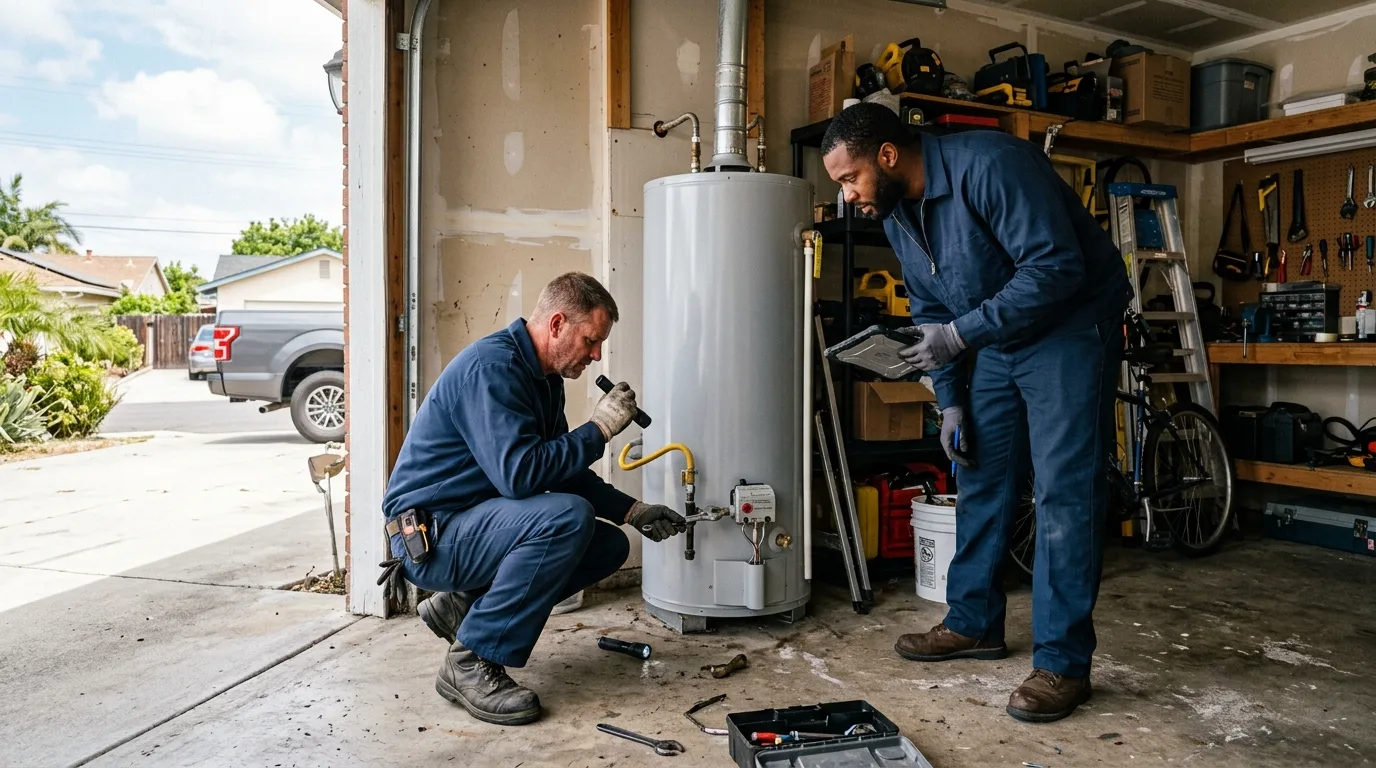
Water Heater Installation
Tank and tankless replacement to California strapping and venting rules.
A tankless unit is a good appliance installed badly more often than it is a bad appliance. Gas capacity, vent routing, condensate and descaling access are the whole job, the box on the wall is the easy part.
Line answered 24/7 · sizing and gas capacity checked before anything is ordered
A tank stores hot water; a tankless unit makes it on demand, so the number that matters is gallons per minute at a given temperature rise. Two showers at once is roughly four to five GPM, and with Norwalk's mild incoming water that is achievable, but only with enough gas behind it.
This is where most retrofits go wrong. A 40-gallon tank might run on a half-inch gas line; a 199,000 BTU tankless unit generally needs three-quarter inch, sometimes with the meter reassessed. Skip that and you get a unit that modulates down, runs lukewarm and gets blamed for the installer's arithmetic.
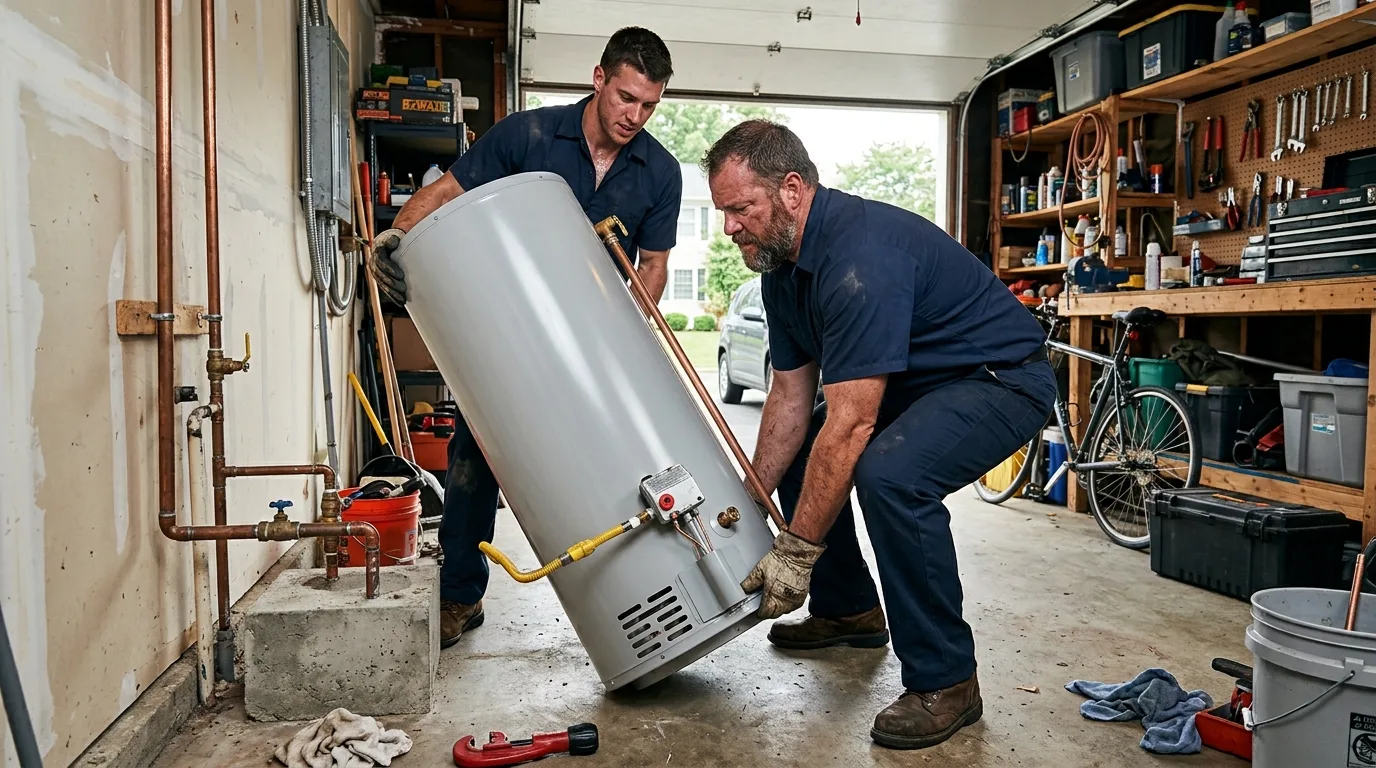
It is an excellent fit for some houses and an expensive mistake in others. The honest version:
Most houses here have the heater in the garage or an exterior closet, which is close to ideal, an exterior wall for the vent, easy gas access, and a drain for condensate usually within reach.
The work that gets underestimated is upstream: upsizing the gas line from the meter, adding dedicated venting in stainless or PVC depending on the unit, running a condensate line on a condensing model, and fitting isolation valves so the unit can be descaled without cutting pipe.
Tankless units are less tolerant of mineral scale than tanks. In this area, annual descaling (or a softener ahead of the unit) is not optional maintenance; it is what keeps the heat exchanger from failing years early.
Fixture count, simultaneous-use expectations, gas line size and meter capacity measured before a unit is specified.
Condensing or non-condensing, indoor or outdoor, BTU rating matched to real peak flow rather than to a brochure figure.
Line upsized where required, sediment trap fitted, and power run for the control board and ignition.
Unit mounted, dedicated venting run to manufacturer specification, and condensate drained properly on condensing models.
Service valves fitted both sides so future descaling is a twenty-minute job, and the old tank removed and hauled away.
Gas pressure checked under load, temperature set, flow tested at two fixtures at once, and the descaling routine shown to you.
Get the gas and venting checked before you buy the unit. The call costs nothing and it changes the budget.
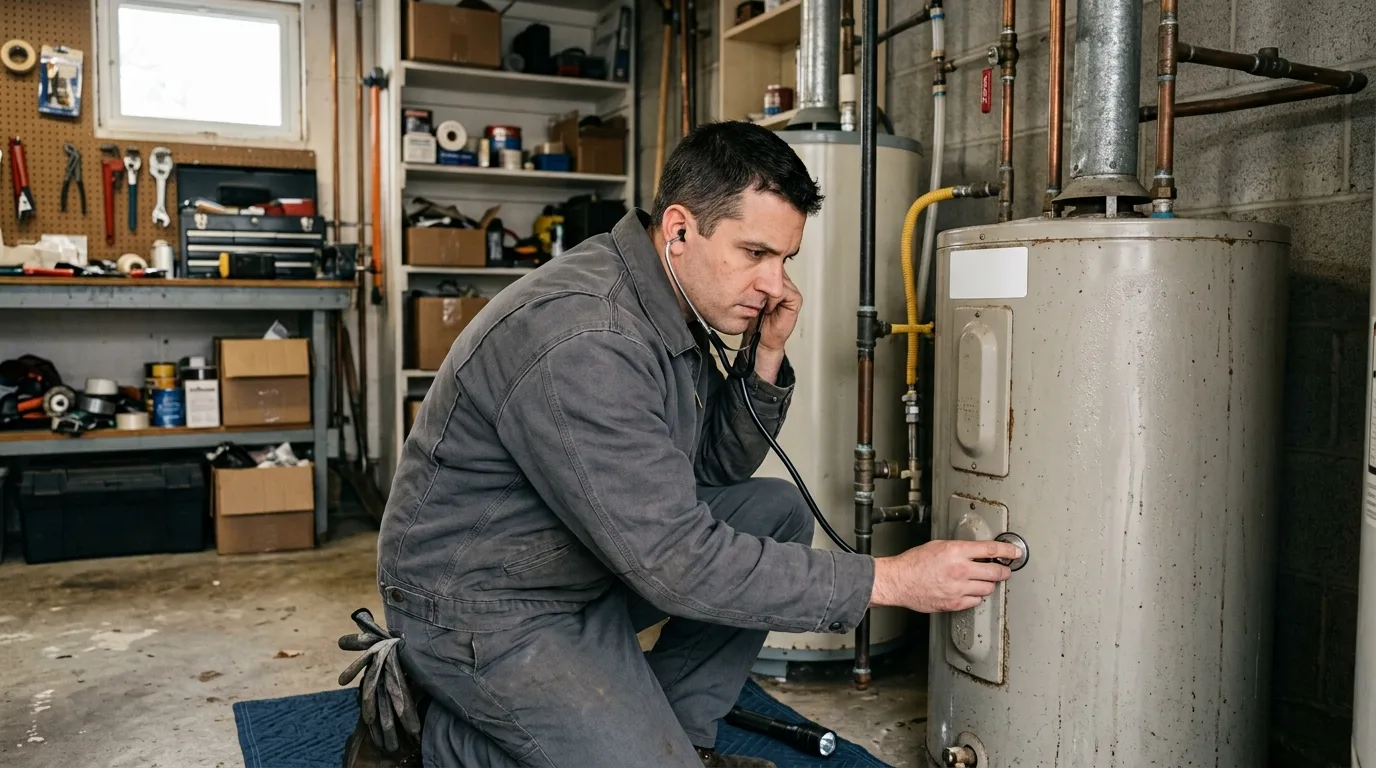
Non-condensing units are cheaper and vent in stainless steel; they run hotter exhaust and slightly lower efficiency. Condensing units capture more heat, vent in PVC, and need a condensate drain, usually the better long-term buy where a drain is available.
Outdoor-rated units suit Southern California and free up interior space entirely, with no venting to run at all. They are exposed to weather and to sun, and in a rare freeze they rely on their own protection and on power staying on.
Recirculation is the other decision. Tankless plus a recirculation loop or a small buffer tank removes the cold-water sandwich and the wait at distant fixtures, worth including at install time rather than retrofitting later.
An emergency is the worst moment to convert. There is usually a way to buy time.
You will get an honest tank-versus-tankless recommendation, including the cases where a tank is simply the better buy.
Worth reading alongside the tankless decision.
Tank and tankless replacement to California strapping and venting rules.
No hot water, rumbling tank, pilot that will not hold, weeping relief valve.
Hard-water treatment that protects heaters, tankless units and fixtures.
Usually, yes. A whole-house tankless unit can demand three to five times the BTU of the tank it replaces. Running it on the old line is the single most common cause of disappointing tankless performance.
Sequentially, correct; it does not store, so it does not deplete. Simultaneously is a different question: exceed the unit's flow rate and the temperature drops. That is why sizing is done on peak simultaneous use.
A short slug of cool water between draws, as the unit fires up again. It is normal on a basic install and it is largely solved by recirculation or a small buffer tank, worth specifying at install.
Annually in this area, more often on hard water without treatment. With isolation valves fitted it is a straightforward service visit; without them it is a much bigger job, which is why the valves go in on day one.
A straightforward garage retrofit with adequate gas is typically one full day. Add a day where the gas line has to be upsized from the meter or venting has to be routed through finished space.
On energy, modest, usually a long payback on efficiency alone. The stronger arguments are lifespan, space, endless sequential hot water, and no 50-gallon flood risk. If you are buying purely on utility savings, a well-sized tank is often the rational choice.
One number covers all of it. If you are not sure which of these your problem is, describe it and we will tell you.
Gas capacity measured, venting done to spec, service valves fitted. Call and get the real scope before you buy a unit.