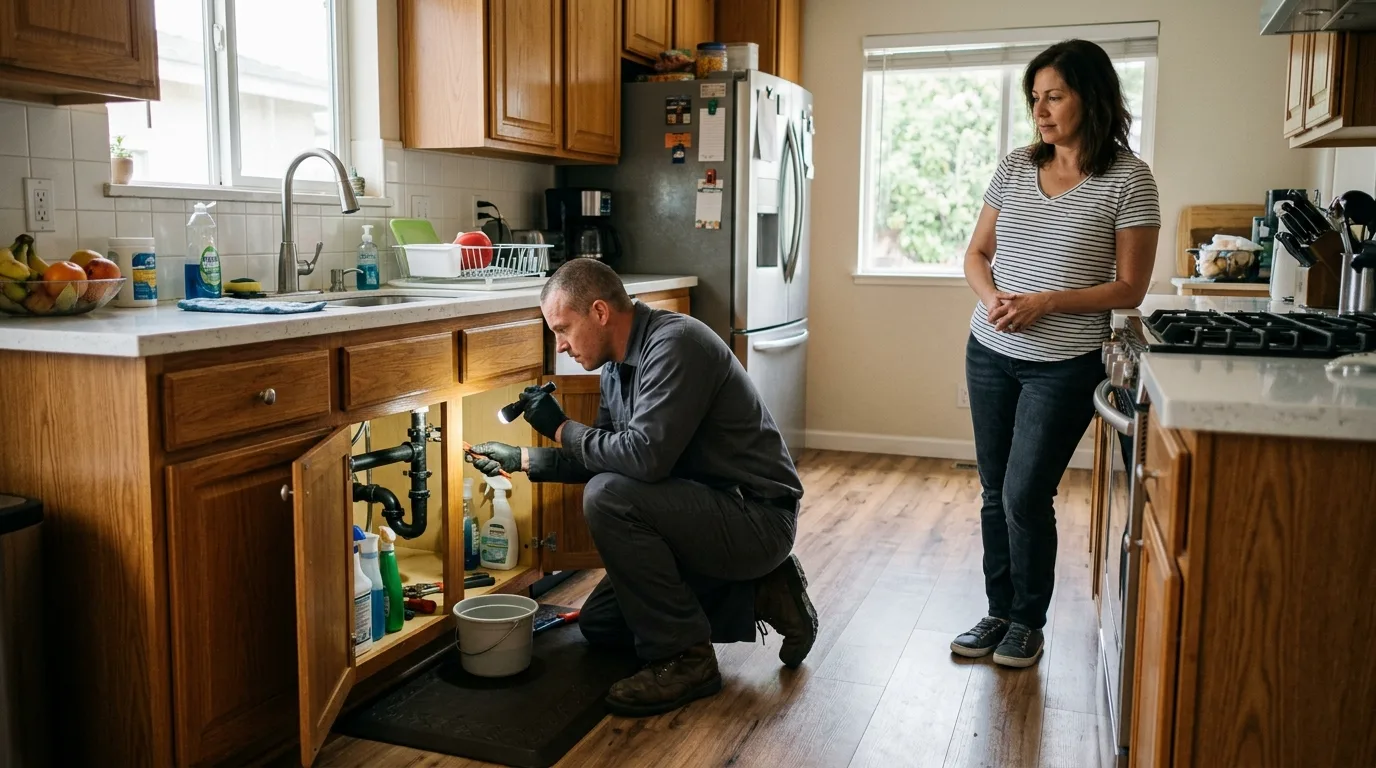
Leak Detection
The equipment and method behind pinpointing a hidden leak.
Warm patch on the floor, water you can hear but not see, a meter that turns with everything shut off. In a slab-on-grade ranch that is a leak under the concrete, and locating it correctly comes before anyone breaks anything.
Shut the main off if you can hear water moving. Then call; we will connect you with a pro who locates before they cut.
Most houses in this city sit directly on a concrete slab with no crawlspace beneath. Some of the water supply (and in many layouts the hot water in particular) runs through or under that slab to reach kitchens and bathrooms. When one of those lines develops a leak, the water has nowhere to drain. It saturates the soil under the concrete, follows the path of least resistance, and eventually shows itself somewhere that may be several feet from the actual failure.
That displacement is what makes slab leaks expensive when handled badly. A warm spot near the hallway does not mean the pipe failed under the hallway. Breaking concrete based on where the symptom appears is how homeowners end up with three holes in a floor and a leak still running. Locating properly (acoustically, with pressure isolation, sometimes with tracer gas) is not an upsell. It is the part that determines how much concrete gets opened.
Hot lines fail more often than cold ones, for reasons that are mostly about expansion. Hot copper moves against concrete and rough fill every time the water heater cycles, and decades of that abrasion wears through. Add hard water inside the pipe and, in some soils, aggressive conditions outside it, and the mechanism is straightforward. It also explains why the first clue is so often a warm floor rather than a wet one.
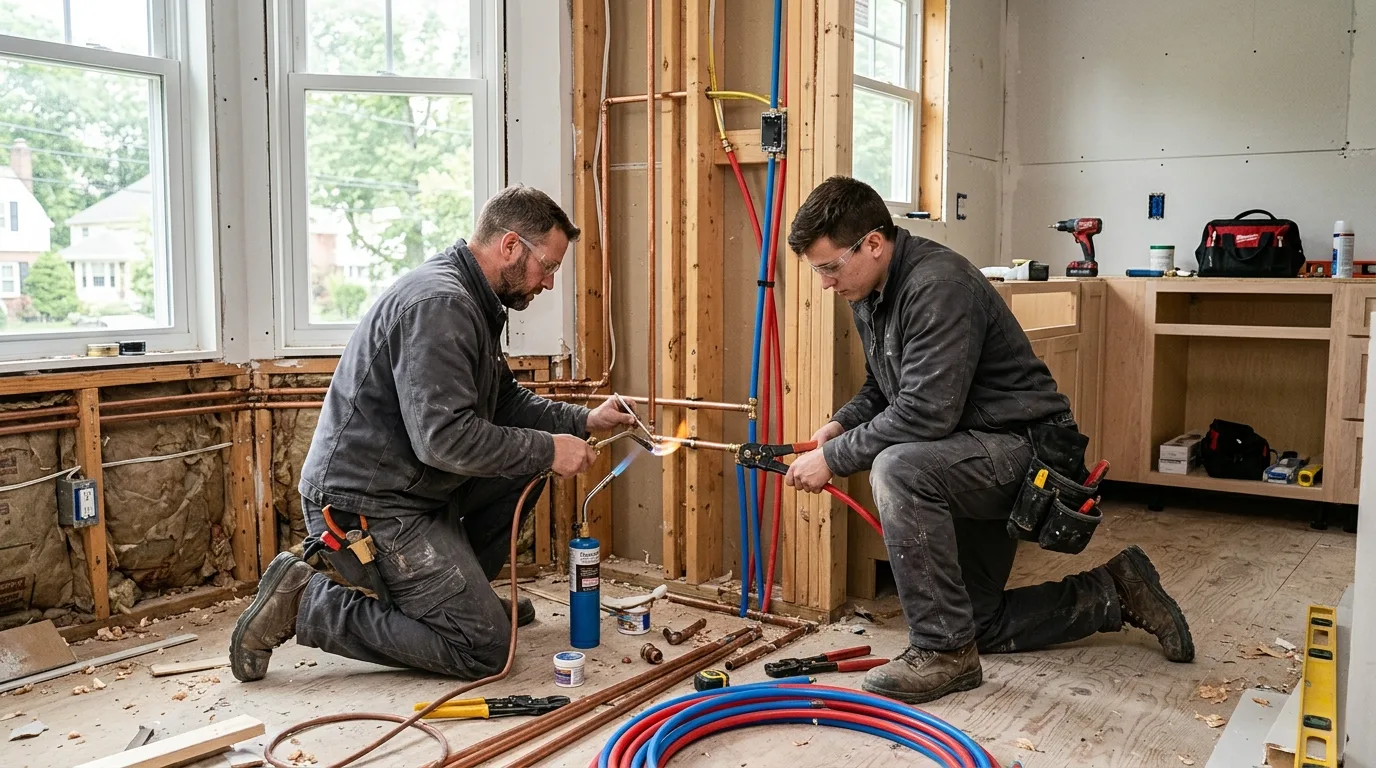 Locate first
Any two of these together justify a phone call. The meter test is the one you can do yourself in five minutes.
The city's building history explains most of it. Norwalk went from dairy and sugar-beet farmland to a fully built suburb in the years around its 1957 incorporation, and slab-on-grade was the standard for that wave of single-story tract construction. It was fast, it was cheap, and it worked well, but it puts pipe under concrete, and that decision is now sixty-plus years old across whole neighbourhoods at once.
The pipe under those slabs is usually copper, sometimes with galvanized elsewhere in the house. Copper under concrete has two enemies: friction and chemistry. Where a line was laid in direct contact with concrete or sharp fill, thermal expansion grinds it thin. Where soil conditions are aggressive or dissimilar metals meet, pitting does the same job from outside in. Neither is dramatic. Both take years and then show up as a warm floor.
Hard imported water is a compounding factor rather than the cause. Scale narrows the bore, raises velocity, and increases turbulence at bends, which is exactly where erosion corrosion likes to happen. It also means the same house often has a scaled water heater and struggling fixtures at the same time the slab line fails, which is why these visits frequently turn into a wider conversation.
Layout matters too. Compact single-story plans put water heaters in garages, hallway closets and exterior closets, and run supply lines the shortest way, which is often straight through the slab rather than around it. In townhouses and condos, stacked plumbing and post-tension slabs in some newer buildings change the options considerably, which is one more reason the building type belongs in the first sentence of your call.
Turn off every fixture and appliance that uses water, including ice makers and irrigation. Go to the meter and watch the small low-flow dial or triangle. If it moves at all, water is leaving the system somewhere. That single observation moves the conversation forward faster than any description of a warm floor.
Meter test, then pressure isolation to establish whether it is on the hot or cold side and whether it is supply rather than drain. Confirming which system is losing water rules out half the possibilities before any equipment comes out.
Acoustic listening equipment picks up the sound of escaping water through concrete; thermal imaging finds the heat signature of a hot-line leak; tracer gas is used where acoustics are inconclusive. The goal is a location you would bet on, not a general area.
Reroute the affected line above the slab, or open the concrete at the leak and repair in place. This is a conversation, not a default, and it depends on the pipe's age, the leak's position and what the rest of the run looks like.
For an open-and-repair: floor covering protected, concrete cut in the smallest workable square, soil excavated, pipe repaired or replaced, pressure-tested, backfilled and patched. For a reroute: new line run through attic and walls, old line abandoned and capped.
Pressure held and verified before any concrete or drywall goes back. Then patching, cleanup, and a clear account of what was found and what was left in place.
If the failed line is the same vintage as everything else under that slab, you deserve to hear what that implies, including whether a full reroute now is cheaper than two more repairs later.
That is water leaving the system. The sooner it is located, the less soil gets saturated and the smaller the repair stays.
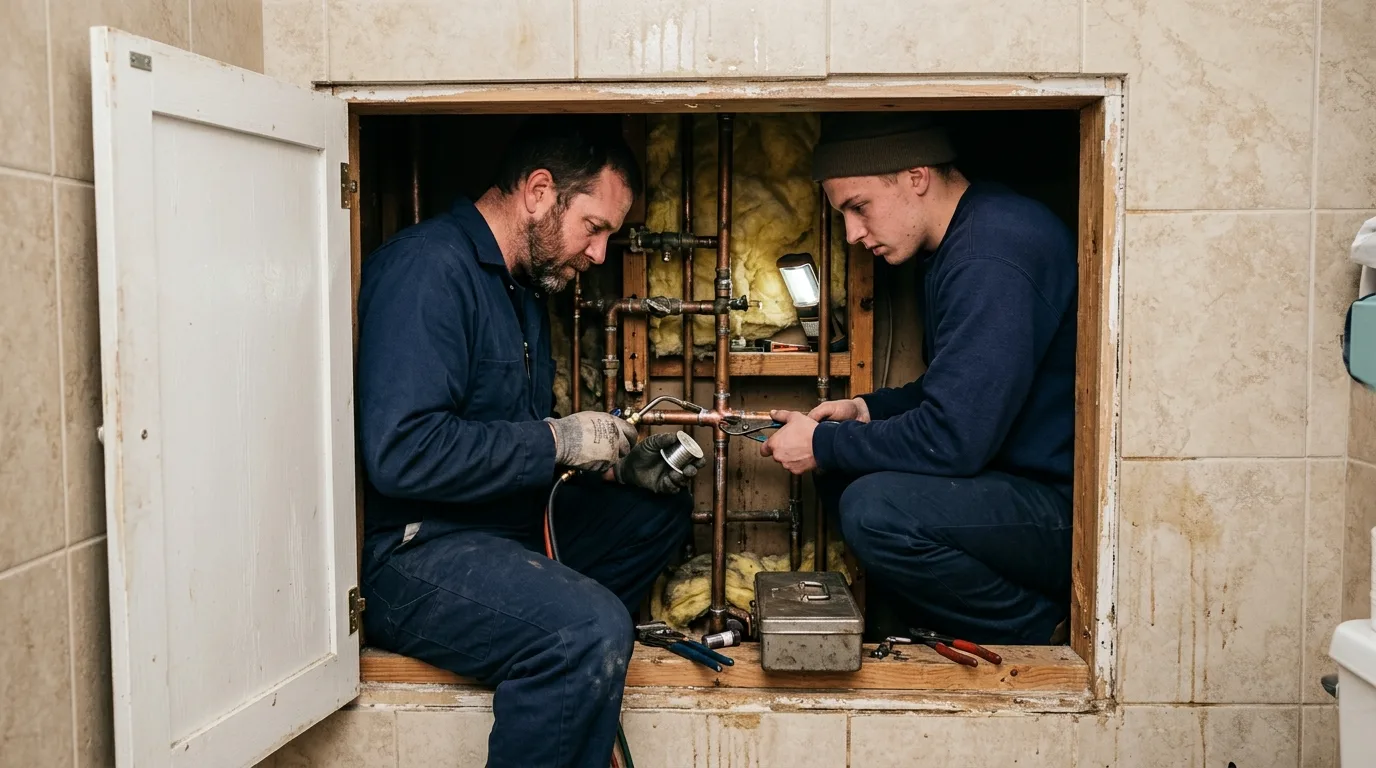 Open only what is needed
Opening the slab is the direct approach: you cut a square of concrete over the located failure, excavate, repair or replace that section of pipe, test it, and put the floor back. It keeps the plumbing layout as designed, it is often the least disruptive to the rest of the house, and when the pipe is otherwise sound it is a proper permanent repair. The costs are the finish floor over the cut, the dust and noise of concrete work, and the risk that a second failure elsewhere on the same aged run puts you back in the same position.
Rerouting abandons the under-slab section entirely. The pro runs a new line (commonly PEX or copper) up a wall, through the attic, and back down to the fixture group, then caps the old run at both ends. Nothing gets excavated. It costs more in pipe and drywall access and it changes the layout, but you never have to think about that section again. On a single-story ranch with attic access, rerouting is frequently the more sensible long-term answer, and it is often the one experienced local pros lean toward when the house is still on original piping.
There are cases where the choice is made for you. A leak beneath a load-bearing element or a post-tension slab pushes strongly toward reroute. A leak under a slab with a beautiful, irreplaceable finish floor does the same. Conversely, a young copper line with a single mechanical injury, sitting under a garage or utility area, is a clean open-and-repair. What you want from the plumber is the reasoning, not the preference, and a price for each option where both are viable.
Nothing here fixes a slab leak, but it limits the damage and speeds up the diagnosis.
Have these ready and the visit gets shorter.
Slab leaks rarely arrive alone in a house of this age. These are the pages homeowners read next.
The equipment and method behind pinpointing a hidden leak.
When rerouting one line turns into replacing all of them.
Above-slab failures in walls, attics and garages.
A heater running constantly is a common slab-leak side effect.
Losses between the meter and the house look similar at the meter.
When the floor is wet tonight and it cannot wait.
Sustained saturation under a slab can move soil, and moving soil is what causes settlement and cracking. That is the reason not to sit on it for months. The realistic picture is that most slab leaks caught within weeks cause a repair problem, not a structural one, but a leak left running for a year, particularly under expansive soil, is a different conversation. Locating and stopping it early keeps you firmly in the first category.
No, and assuming it is costs people money. Water under a slab spreads along the path of least resistance, so the heat signature can appear feet away from the failure. Concrete also conducts heat sideways. That is exactly why acoustic locating, pressure isolation and sometimes tracer gas are used, to convert a general area into a spot worth cutting.
With a good location, typically a square measured in feet rather than a trench across the room. The pro cuts the smallest opening that gives working access to the pipe, excavates, repairs, tests, backfills and patches the concrete. If your finish floor is irreplaceable, say so early; it often tilts the decision toward rerouting instead.
It depends on the pipe's age, the leak's location, your floor finish, and attic access. A single injury to otherwise sound pipe under a garage is a straightforward open-and-repair. Original 1950s or 60s copper failing under a finished room, in a house that has never been repiped, usually points toward rerouting that line above the slab so you are not back in six months. Ask for both prices where both are genuinely viable.
Locating is usually a couple of hours. An open-and-repair is commonly a day on site, plus concrete cure and floor finishing afterward. A single-line reroute is often a day to a day and a half depending on the run. A full reroute of all under-slab supply lines is a multi-day job. None of it is instant, which is another argument for calling at the first symptom.
Usually, yes, and the bill history is useful evidence. A slab leak leaks continuously, so consumption rises and stays risen rather than spiking once. Two or three cycles of steady increase with no change in household use is a strong signal. Some water providers will discuss a leak adjustment once a repair is documented, so keep the invoice.
Yes, and it presents differently. Drain-line leaks under a slab do not spread continuously because the pipe is not pressurised; you tend to get damp that comes and goes with use, along with odour. That points at cast-iron drain lines under the slab, which in houses of this era is a real possibility. Camera inspection rather than acoustic locating is the tool for that diagnosis.
Coverage varies a great deal by policy, and we cannot tell you what yours includes. As a general pattern, resulting water damage is treated separately from the cost of accessing and repairing the pipe itself, and documentation matters. Photograph everything, keep the locating report and the invoice, and ask your carrier specifically about both parts.
Meaningfully, yes. Shared slabs, stacked plumbing and common shutoffs mean the leak may not be yours alone, and the HOA usually has a defined boundary between unit and common responsibility. Some newer buildings also sit on post-tension slabs, where cutting concrete is restricted and rerouting becomes the practical option. Mention the building type when you call.
Not sensibly. Unlike a dripping tap, a slab leak runs continuously, saturates soil, drives up the bill every month, and gets worse rather than stabilising. It also tends to take your water heater with it, since the heater keeps working to replace hot water it never delivers. The cheapest version of this problem is always the one you address early.
One number covers all of it. If you are not sure which of these your problem is, describe it and we will tell you.
We will connect you with a local pro who locates slab leaks properly in Norwalk, CA houses and explains both repair routes honestly.