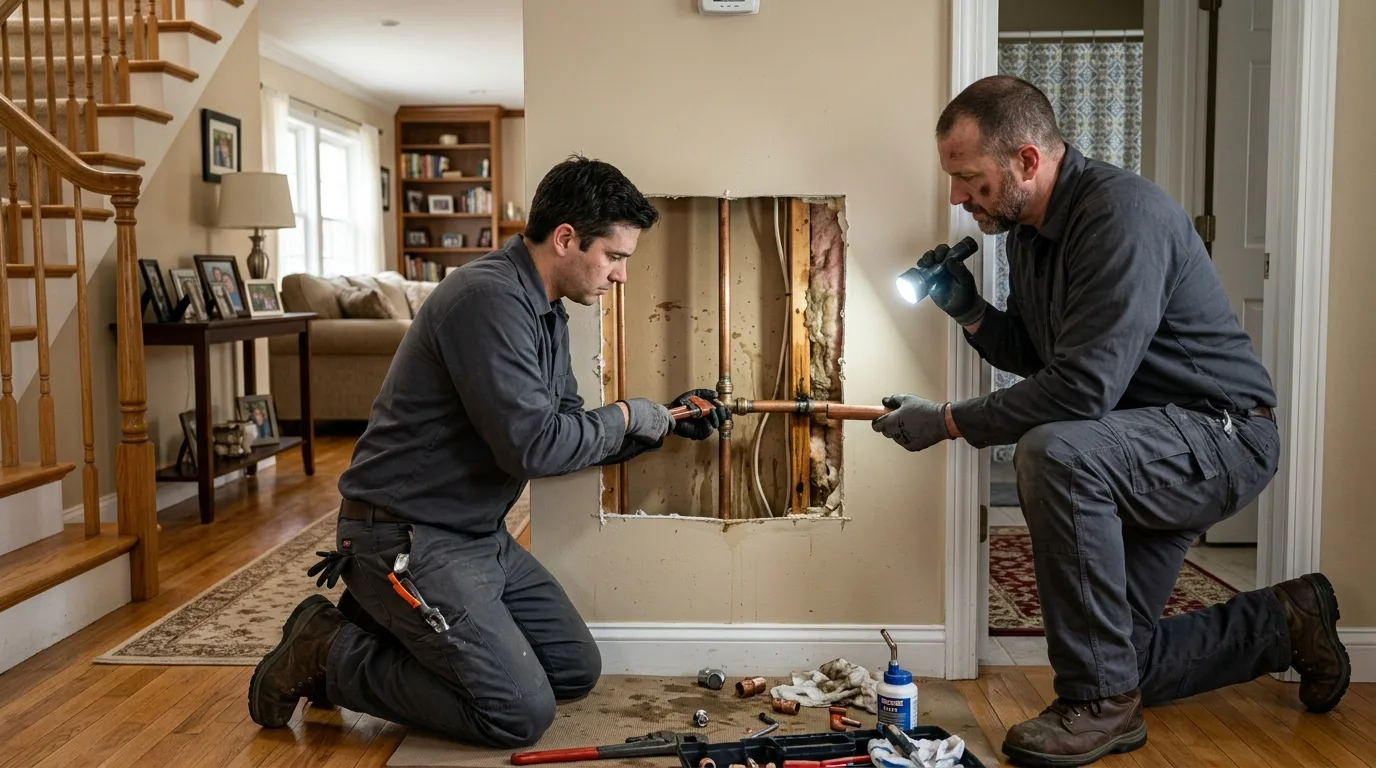
Burst Pipe Repair
Isolating the split, cutting back to sound pipe, and deciding whether the run stays.
Water where it should not be, a main line backing up into the house, or no water at all. Call, and we will connect you with a local plumbing pro who is working tonight, not tomorrow afternoon.
Answered by a person at any hour. If a line is open, the first thing we do is walk you to your shutoff.
Plenty of plumbing problems can hold a few days. A dripping faucet, a toilet that runs for ten seconds after every flush, a slow bathroom sink, those are annoyances, and you should get them fixed, but nothing is being destroyed while you wait. An emergency is different. An emergency is a problem that is actively causing damage, making the house unsafe, or taking away something the household cannot do without.
In practice that means four categories. Water under pressure that you cannot stop: a burst supply line, a failed water heater connection, a hose bibb that sheared off. Wastewater coming back into the house: a main-line stoppage pushing sewage up through a shower pan or a floor drain in the garage. No water at all, which usually means a main line or meter-side failure. And gas, any smell of gas gets the utility first and a plumber second.
The reason to call immediately rather than in the morning is not urgency for its own sake. It is that the cost curve on water damage is brutally steep. A supply line spraying inside a wall for eight hours soaks framing, insulation and drywall, wicks into slab, and starts a mould problem you will be paying for months later. The same leak caught in twenty minutes is a fitting and a patch.
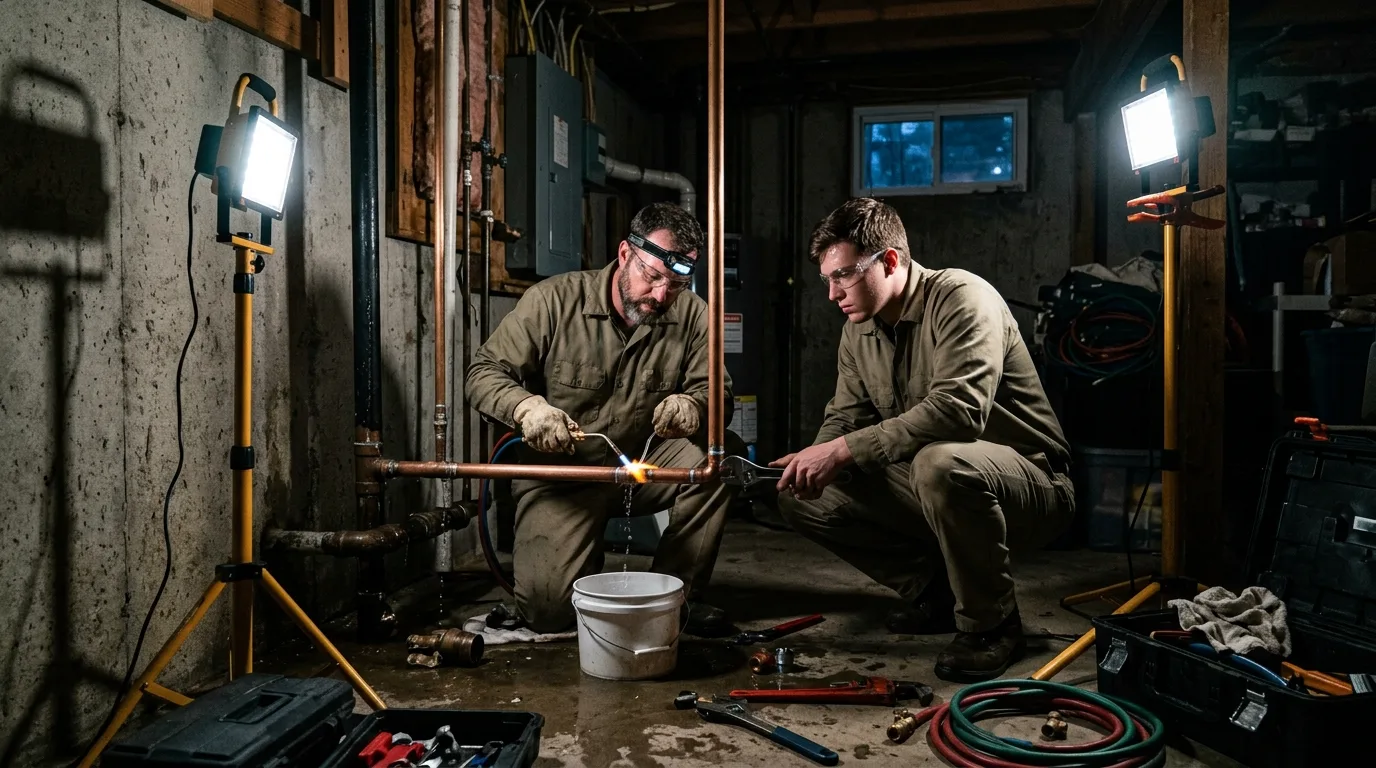 Active leak
You do not need a diagnosis to make the call. Describe what you can see and hear, and we will sort out which trade you need.
This city filled in fast. Norwalk was dairy pasture and sugar-beet acreage until it incorporated in 1957, and most of its housing stock went up in the boom that immediately followed. That compressed buildout is why emergencies here arrive in patterns rather than at random. Streets plumbed within a couple of years of each other are running the same galvanized steel supply lines and the same cast-iron or clay sewer laterals, at the same age, under the same water chemistry.
Galvanized pipe fails from the inside. The zinc goes, the steel rusts, the interior diameter closes down, and at some point a thin spot gives way, usually at a fitting, usually at two in the morning when nobody is watching. Cast-iron laterals scale and crack, and clay joints let in roots from the parkway trees that make these blocks pleasant to walk down. When a root mat finally catches a full load of wastewater, the backup is sudden even though the cause took fifteen years.
Slab-on-grade construction adds its own emergency category. In a house with no crawlspace, a failed pressurized line under the concrete has nowhere to go, so it saturates the soil, works sideways, and shows up as a warm floor or a hairline crack rather than a puddle. And with most water heaters sitting in a garage, a hallway closet or an exterior closet, a tank that lets go dumps forty or fifty gallons directly onto finished floor or into the stored contents of a garage.
Add the freeway grid and the picture is better than it sounds. The I-5 and I-605 run either side of the city and the Metro C Line crosses it, which is why a pro finishing a job in Downey or Artesia can be at a Norwalk address quickly at almost any hour.
Find your main shutoff before you ever need it. In most Norwalk houses it is at the street-side meter box or on the riser at the front of the building, and it takes a meter key or a quarter-turn on a ball valve. Two minutes on a calm afternoon saves a room.
Before anything else we establish whether water is still moving and whether you can stop it. If you can, we talk you to the valve. That single step often turns an emergency into a scheduled repair, and it costs you nothing.
Not every plumber runs nights, and not every night plumber does sewer work. We get you a licensed professional who covers your district and does that specific kind of repair, main line, slab, heater, gas.
The pro confirms the source rather than guessing at it, explains what the repair takes, and gives you the number first. You approve it before anything is cut, dug or opened.
Some emergencies are a two-stage job: stop the damage tonight, complete the permanent repair once supply houses open or a permit is in hand. If that is your situation you will be told plainly, along with what the second visit involves.
You get told what failed, what was replaced, what to watch, and whether the rest of the run is on the same clock. If something is not right afterwards, call us and we arrange the return visit with the pro who did the work.
Overnight, weekends, holidays, the line is answered the same way it is at noon. Describe it and we will move.
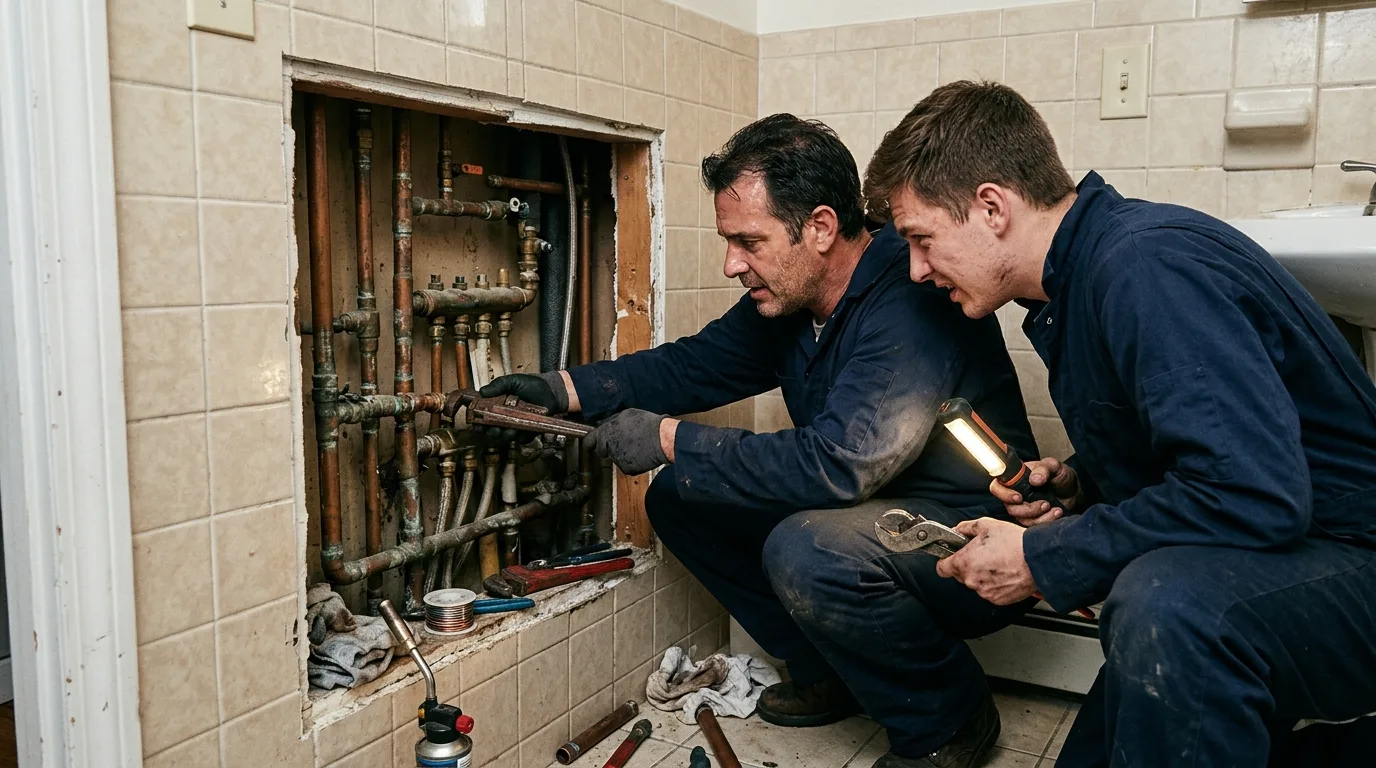 After-hours call
There is an honest distinction worth understanding before the truck arrives. Stopping the damage and fixing the underlying problem are sometimes the same job and sometimes not. A split copper elbow is a one-visit repair: cut it out, sweat or press in a new fitting, pressure-test, done. A galvanized main that opened up because the whole run is corroded can be patched tonight, but the patch is a bridge to a repipe, and any pro who tells you otherwise is selling you a second emergency in six months.
The same applies to sewers. A cable run at midnight restores flow so the household can use the bathroom, but if the cause is a root mass at a clay joint, the line will close again. The permanent answer is a camera run in daylight, then jetting, a spot repair, or trenchless lining depending on what the camera shows. Doing the emergency work first is correct, just do it knowing which of the two you are buying.
Water heaters are the clearest case. A failed thermocouple, a burnt element, a stuck gas valve, those are repairs. A tank leaking from the shell is not repairable at any price, and a pro who offers to weld it is not one you want in your garage. If your heater is over ten years old and the water is coming from the body rather than a fitting, plan on replacement and ask about strapping and venting while the old unit is out.
Order matters here. Stop the water, protect the people, then protect the property.
It takes one sentence each and it is the difference between the right pro and a second visit.
Most after-hours calls in this city end up being one of these five jobs. Each page covers how the repair actually works.
Isolating the split, cutting back to sound pipe, and deciding whether the run stays.
Warm floors and a spinning meter in a slab-on-grade ranch.
Main-line stoppages cleared, then the cause identified rather than guessed.
Which failures are worth repairing and which mean the tank is finished.
When cabling stops being enough and the lateral itself needs work.
Odours, old unprotected runs, and earthquake shutoff valves.
Yes. The dispatch line is answered by a person 24 hours a day, every day of the year, including holidays. You will not get a recording asking you to leave a message and wait for business hours. What you get is someone who will ask a handful of questions, help you stop the water if it is still running, and tell you honestly how soon a local pro can be at your address.
There is a premium for nights, weekends and holidays; that is true of every trade, and any site telling you otherwise is not being straight with you. The plumber we dispatch gives you the price before starting, so you can weigh it against waiting. For an active leak that decision is usually easy: an hour of running water costs more than the after-hours difference. For a slow drain, waiting until morning is often the sensible call, and we will say so.
Stop the water. Your main shutoff is usually at the street-side meter box or on the riser at the front of the house. Close it, then check whether the leak slows or stops; that tells the pro a great deal before they arrive. If it is a drain or sewer problem rather than a supply problem, the equivalent first move is to stop using water anywhere in the house.
Yes, and mention it when you call. Stacked plumbing and shared walls mean the shutoff serving your unit may serve others, the failure may originate in a neighbouring unit, and the HOA generally needs to be notified before walls are opened. A pro who knows that walking in brings the right expectations instead of discovering the situation in your hallway at midnight.
It is treated as one, yes. Total loss of pressure usually means something on the main between the meter and the house, a failed pressure regulator, or occasionally a utility-side issue. Check whether a neighbour has water, because that answers half the question immediately. Either way, call, a house with no water is not a situation to sit on overnight with kids or elderly family at home.
The utility, first, from outside the house. Get everyone out, do not flip switches, do not light anything, and do not go looking for the source. The utility will make the situation safe and shut off supply. Once that is done, call us, repairing or replacing the line, the appliance connector, or the shutoff valve is plumbing work, and it is what gets your gas turned back on.
Depends on the failure. A split fitting, a bad flex line, a stoppage in a fixture branch, those finish in one visit. A corroded galvanized main, a sewer lateral with root intrusion, or a slab leak in a run that is the same age throughout gets stabilised now and repaired properly on a scheduled visit, sometimes with a permit involved. You will be told which of those you are in before work starts, not after.
The plumber who performed the work stands behind it, and we coordinate the return visit if something is not right. Ask for the terms in writing before they leave, a good plumber expects that question. Note that a deliberate temporary repair, agreed with you as a bridge to a permanent fix, is a different thing and should be described that way on the paperwork.
Yes. Cerritos, Bellflower, Downey, Santa Fe Springs, La Mirada, Artesia and Whittier are all inside the coverage area, plus Paramount, Lakewood, Buena Park and La Palma. At night the freeways are clear, which in practice means an overnight arrival window across this part of LA County is often better than a mid-afternoon one.
Talk to us first, thirty seconds of conversation gets the water off and gets a pro moving. Photos are genuinely useful afterward for the plumber heading your way, especially of a heater's data plate, a cleanout location, or the pipe material at a visible joint. But nothing gets dispatched off an unread photo, so make the call.
One number covers all of it. If you are not sure which of these your problem is, describe it and we will tell you.
Emergency tonight or a repair you would rather book for Tuesday, same line, same conversation, a local pro either way.