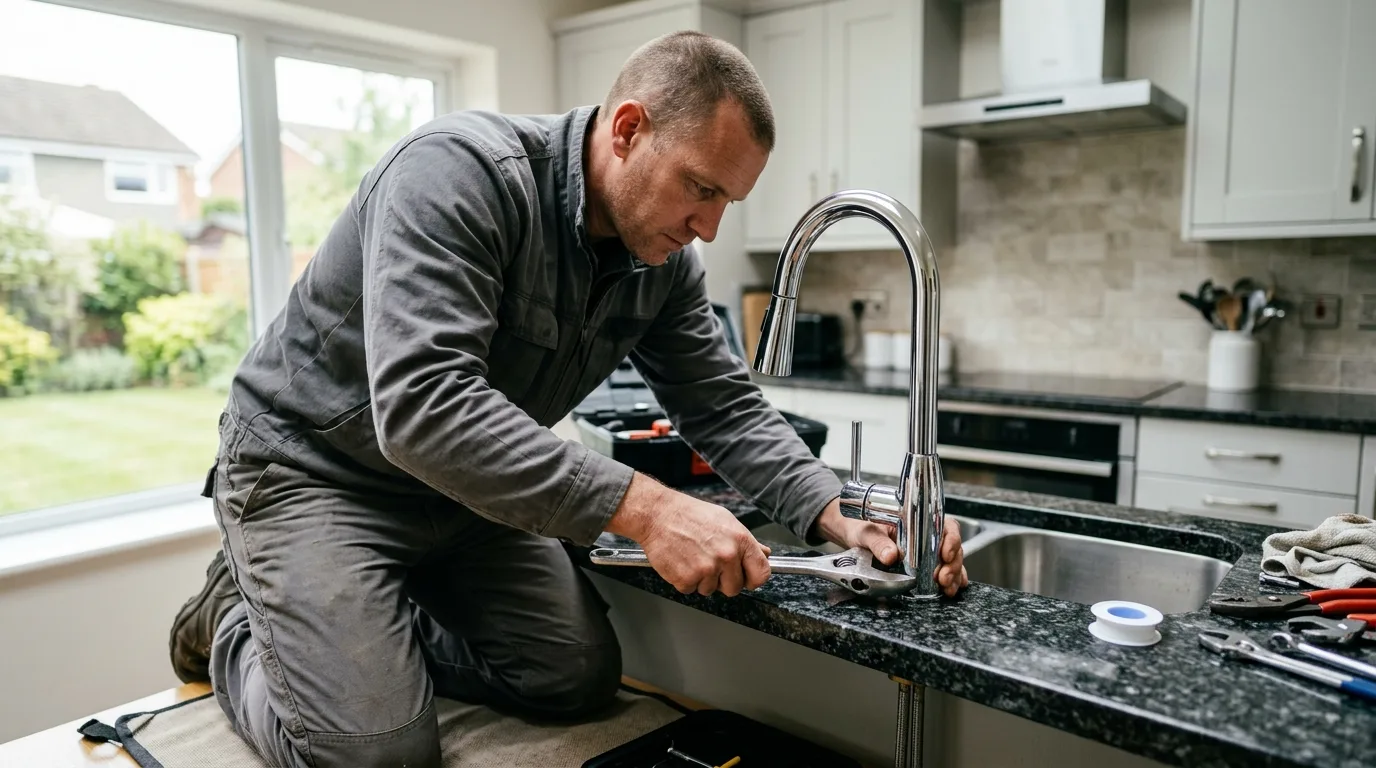
Emergency Plumbing
Answered around the clock for active leaks, backups and no-water situations.
Downey has real range, pre-war houses near the older core, big postwar tracts, and newer infill on the same blocks. Which era your house belongs to decides almost everything about the repair.
Line answered 24/7 · same-day and emergency response
Pre-1950 houses here often still run galvanized supply and cast-iron drains, both at the end of their service life. Postwar tracts follow the familiar copper-and-clay pattern. Newer construction is generally sound, and the calls from it are fixture-level.
So the first question on any Downey call is the build year. It moves the likely diagnosis more than the symptom does.
 Mixed eras
Weighted toward the older housing, where the supply and drain systems are both aging at once.
Downey is a short dispatch from Norwalk and covered on the same 24/7 rota. Emergency work is routed to whoever is closest and free; scheduled work gets a time window rather than a vague day.
On any Downey house built before 1960, a sewer camera run and a look at the supply material are the two inspections that most often change the price. Both are cheap relative to what they find.
Get the material identified and the options priced properly. Call any hour.
We cover Downey for all of it. These six recur regardless of which era your block was built in.
Answered around the clock for active leaks, backups and no-water situations.
Located under concrete, then rerouted or opened, with the reasoning explained.
Kitchen, laundry, tub and main-line stoppages cleared and diagnosed.
Cracked clay and rusted cast-iron laterals repaired or replaced.
Tank and tankless replacement to California strapping and venting rules.
Copper or PEX through a single-story ranch, sequenced to keep water on.
Downey spread quickly in the 1950s and 60s, and most of that housing is slab-on-grade with soft copper supply lines run in or under the concrete. Those lines have now been in service long enough that pinhole failures are routine rather than unlucky. Because the pipe is encased, the water rarely appears where the leak is; it tracks along the slab and shows up as a warm spot on a tile floor, a damp edge of carpet by an exterior wall, or nothing at all except a meter that will not sit still.
The first job is confirming it is a slab leak and not a hose bib, an irrigation line or a failing water heater. Shut everything, watch the meter, then locate acoustically and with pressure isolation before any concrete is considered. Cutting the slab is the last option, not the first: a reroute overhead through the attic and down the wall is frequently faster, cheaper and less disruptive than jackhammering a finished floor.
Groundwater in this part of the basin is hard, and scale is the reason water heaters here often fail earlier than their labels suggest. A tank that rumbles has a sediment bed on the bottom cooking against the burner. Flushing helps if it is done before the bed sets; after that, the honest advice is usually replacement rather than repair.
If it is still on original galvanized supply, effectively yes; that material is past its design life everywhere in this area. The real question is timing and staging, and a pro can tell you which runs are worst and whether staging makes sense for your budget.
Cast iron fails from the inside, usually along the bottom of horizontal runs. A camera inspection shows how much wall is left. Options run from descaling and jetting on sound pipe, through lining, to replacing the stack, and the footage is what tells you which.
Yes. Water heater replacement, repipes, sewer work in the right-of-way and gas line work are permitted jobs, and the inspection is what confirms the install was done to code. That is part of the scope, not an extra you chase yourself.
If the pipe elsewhere is sound and the leak is a single point, a spot repair through the slab can make sense. If the run has already leaked once, or the copper is thin throughout, rerouting that line overhead is the repair that does not come back. We will price both and explain which one the pipe actually justifies.
Most single-line reroutes are a one-day job, sometimes two if drywall access is awkward or more than one line is involved. Patching and paint are usually separate from the plumbing work, and we will tell you that up front rather than after.
Same dispatch, all of these. Downey is large enough that its edges touch several of them, so give us the cross street and we will work it out.
Tell us the cross-streets and what the house is doing. Upfront pricing before any work begins.