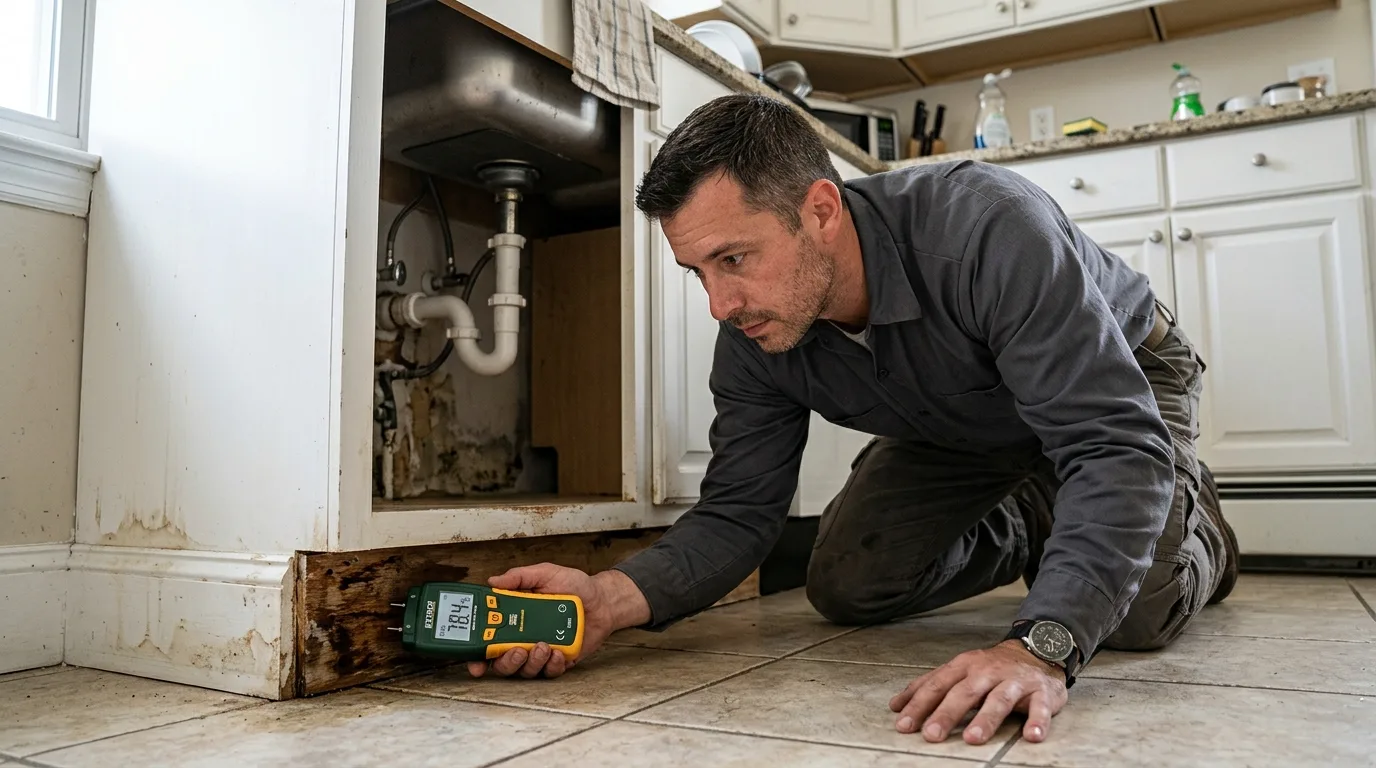
Slab Leak Repair
Reroute above the slab or open the concrete, decided on evidence.
Something is losing water and nothing is visibly wrong. Before anyone cuts drywall or concrete, the leak gets found, acoustically, with pressure isolation, and with thermal imaging where it helps.
Bring the meter reading and the symptom. We will connect you with a pro who owns the right equipment.
There are two ways to deal with a hidden leak. One is to look at where the damp shows up and start opening things until you find water. The other is to prove where the leak is before touching finish material. The second costs a little on the day and saves a great deal in patching, repainting, retiling and second visits, and it is the difference between a professional diagnosis and an expensive search.
Hidden leaks in this city fall into a few families. Supply leaks under a concrete slab, which spread through soil and surface far from the source. Supply leaks inside walls, where gravity and framing send water somewhere unexpected. Drain and sewer leaks, which come and go with use and often announce themselves by smell before sight. Irrigation and hose-bibb losses outside, which quietly account for a surprising share of mysterious bills. And appliance or connector leaks that look like plumbing failures but are not.
Detection work sorts those out in order, cheapest test first. Is water leaving the system at all, and is it the pressurised side or the drain side? Which zone of the house? Then, and only then, precisely where. A pro who reaches for a jackhammer before completing the first two steps is guessing with your floor.
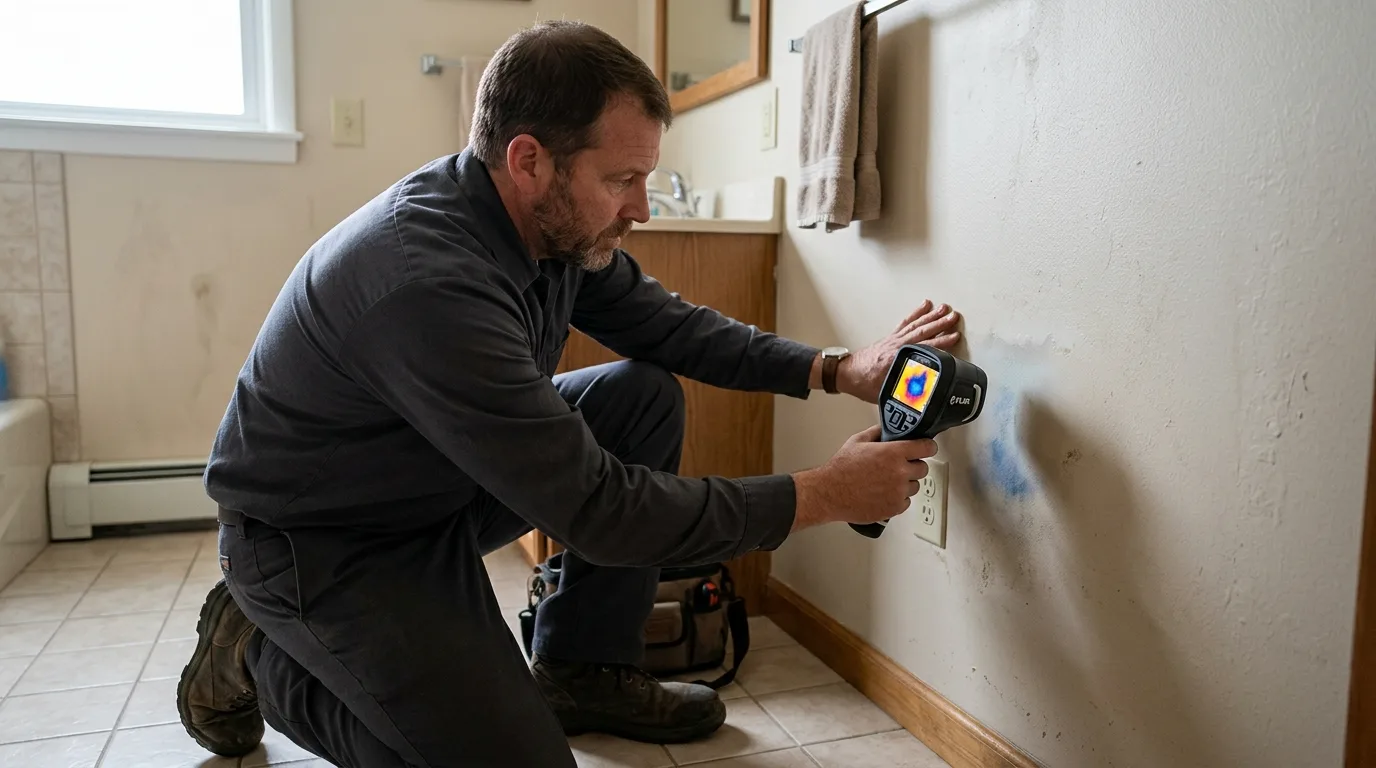 The meter test
Any of these, especially in combination, means the leak is real and hidden rather than imagined.
Construction here works against easy visibility. Slab-on-grade means no crawlspace to inspect, so a supply line failure under the floor has no accessible path and no telltale drip into a basement. Single-story ranch layouts run pipe through attics and slab rather than through open utility spaces. And because so much of the housing stock went up in the compressed boom after the city incorporated in 1957, the pipe involved is usually old enough to fail quietly at a joint rather than dramatically at a straight run.
Material behaviour adds to it. Galvanized steel corrodes from the inside and weeps before it bursts, so the early stage of failure produces a slow, intermittent seep that dries between uses. Copper pinholes spray a fine mist that saturates insulation and drywall without ever pooling on a floor. Cast-iron drain lines under a slab crack along the bottom, so leaks only occur while wastewater is flowing, which is why a drain leak can be invisible for months and then show up as one damp patch after laundry day.
Then there is everything outside the house. Irrigation valves, drip lines, hose bibbs and pool equipment all sit on the same meter, and in a warm, dry climate they run a lot. Detection work routinely finds that a homeowner convinced they had a slab leak actually had a cracked irrigation lateral, which is a much better outcome and one you only get by testing rather than assuming.
If your house has a shutoff where the main enters the building, close it and watch the meter again. Meter still turning means the loss is between the meter and the house, main line or irrigation. Meter stops means the loss is inside. That one test splits the problem in half in about five minutes.
The meter is read over a timed interval with the house shut down, so the pro knows whether the loss is a trickle or a genuine flow. That number shapes everything after it.
Closing the house valve separates yard and main-line losses from interior ones. Isolating hot from cold at the heater narrows it further. Drain-side suspicion moves the job toward camera work instead.
The relevant section is isolated and pressurised, then watched on a gauge. A pressure drop with no visible water is proof of a leak in that zone, and a stable gauge rules the zone out.
Acoustic equipment amplifies the sound of water escaping under pressure, which carries through concrete, soil and framing. Combined with a floor-by-floor grid pattern, this is what turns a zone into a spot.
Thermal imaging shows the heat plume of a hot-line leak. Tracer gas is used where acoustics are ambiguous, the gas escapes through the failure and is picked up at the surface. Two agreeing methods is a location worth cutting.
You get told where it is, what it most likely is, and what the repair options and prices are. Detection and repair are separate decisions, and you are entitled to make them separately.
A continuous hidden leak shows up on every bill until it is found. Detection ends the guessing in a single visit.
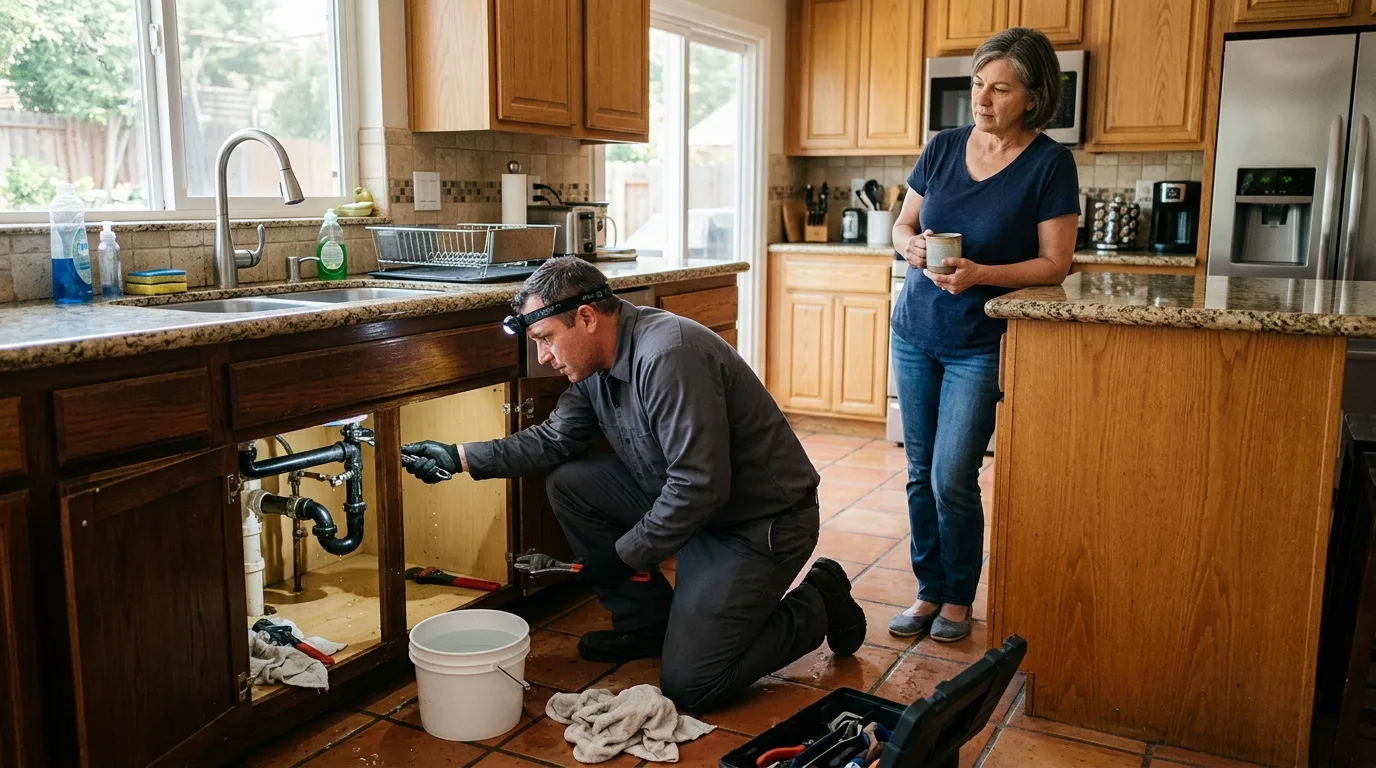 Acoustic tracing
Acoustic listening is the workhorse. Water forced through a small opening makes noise, and that noise transmits through pipe, concrete and soil. Ground microphones and contact probes let a trained ear localise it to within a small area. It works best on pressurised lines, works less well through thick tile or on very small seeps, and depends heavily on the operator's experience; this is a skill, not a gadget.
Pressure isolation and gauge testing is the cheapest and most conclusive first step. It cannot tell you where, but it tells you definitively whether and roughly which system. Any detection visit that skips it is doing extra work for no reason.
Thermal imaging reads surface temperature differences. It excels at hot-water slab leaks, where a warm plume spreads under flooring, and at finding wet insulation inside a wall. It cannot see through everything and it will show you plenty of harmless temperature variation, so it is a confirming tool rather than a standalone one.
Tracer gas is the tie-breaker. A safe gas mix is introduced into the drained line and escapes at the failure point, where a surface probe picks it up. It is excellent through concrete and under landscaping. Camera inspection covers the drain side; you cannot pressure-test a sewer lateral, so for drains the answer is to look inside the pipe. Most real jobs use two or three of these together, and the combination is what makes the result trustworthy.
Twenty minutes of preparation can shorten a detection visit substantially.
Detail here directly reduces time on site.
Finding the leak is step one. These are the repairs a detection visit most often leads to in this city.
Reroute above the slab or open the concrete, decided on evidence.
Wall, attic and garage supply failures.
When the loss is between the meter and the house.
The drain-side equivalent of leak detection.
High pressure creates leaks faster than anything else.
When detection keeps finding new leaks in the same old runs.
That is the entire point of the work. Acoustic listening, pressure testing, thermal imaging and tracer gas are all non-destructive; they identify the location so that the repair opens the smallest possible area. Occasionally a small inspection opening is needed to confirm, and that is agreed with you first. What detection prevents is the alternative: opening several places hoping to find water.
With good equipment and an experienced operator, a pressurised-line leak under a slab is typically located within a small area, close enough that the repair cut is a modest square rather than a trench. Accuracy drops with very small seeps, multiple leaks, heavy floor coverings and high ambient noise. A conscientious pro will tell you their confidence level rather than pretending to a precision they cannot deliver.
Yes, for two reasons. Continuous losses add up on every bill, and small leaks do not stay small, corrosion accelerates at a failure point, and saturated framing or soil creates a second, more expensive problem. A pinhole found this month is a fitting. The same pinhole in a year is drywall, insulation, flooring and possibly mould remediation.
Very often, and it is one of the first things a good detection visit rules in or out. Irrigation lines, valves and drip systems sit on the same meter, run frequently in this climate, and leak underground where nothing shows. Closing the house valve and watching the meter separates the two in minutes, which is why that test comes before any equipment is unpacked.
Gas is handled differently and it is a safety matter first. If you smell gas, leave the house and call the gas utility from outside; they will make it safe and shut off supply. Once that is done, a plumber handles the repair or replacement of the line, connector or valve. We can connect you with a pro for that work, and for earthquake shutoff valve installation while they are there.
Different tools. Drain lines are not pressurised, so pressure testing and acoustics do not apply in the same way. The answer there is a camera run through a cleanout, which shows cracks, offsets, root intrusion and bellies directly. In houses of this era with cast-iron or clay laterals, that is a common outcome, and the camera footage is also the basis for deciding between spot repair, jetting and trenchless lining.
Commonly one to three hours depending on how many zones need isolating and how cooperative the acoustics are. A straightforward hot-line slab leak with clear symptoms can be located quickly. A very small intermittent seep across a large floor plan takes longer, and occasionally requires a return visit under different conditions. You will be told the scope before work starts.
Often, yes, if the repair is accessible and you approve the price. Sometimes not, concrete work, a permit, or a part that has to come from a supply house can push the repair to a scheduled follow-up. Detection and repair are priced separately for a reason: you are entitled to know where the leak is and then decide how you want it handled.
Two things, both useful. Run the meter test with everything off, and if you have a separate house shutoff, run it again with that closed. Between them you learn whether water is genuinely leaving the system and whether the loss is inside or outside. Beyond that, avoid opening walls or floors on a hunch; that is where money gets spent for no information.
Yes. Cerritos, Bellflower, Downey, Santa Fe Springs, La Mirada, Artesia and Whittier are all within the coverage area, along with Paramount, Lakewood, Buena Park and La Palma. Housing stock differs a little city to city, and the pros who work these areas know the difference between a 1950s Norwalk tract slab and a 1970s Cerritos build.
One number covers all of it. If you are not sure which of these your problem is, describe it and we will tell you.
One call connects you with a local pro who owns the equipment and knows how Norwalk, CA houses are built.