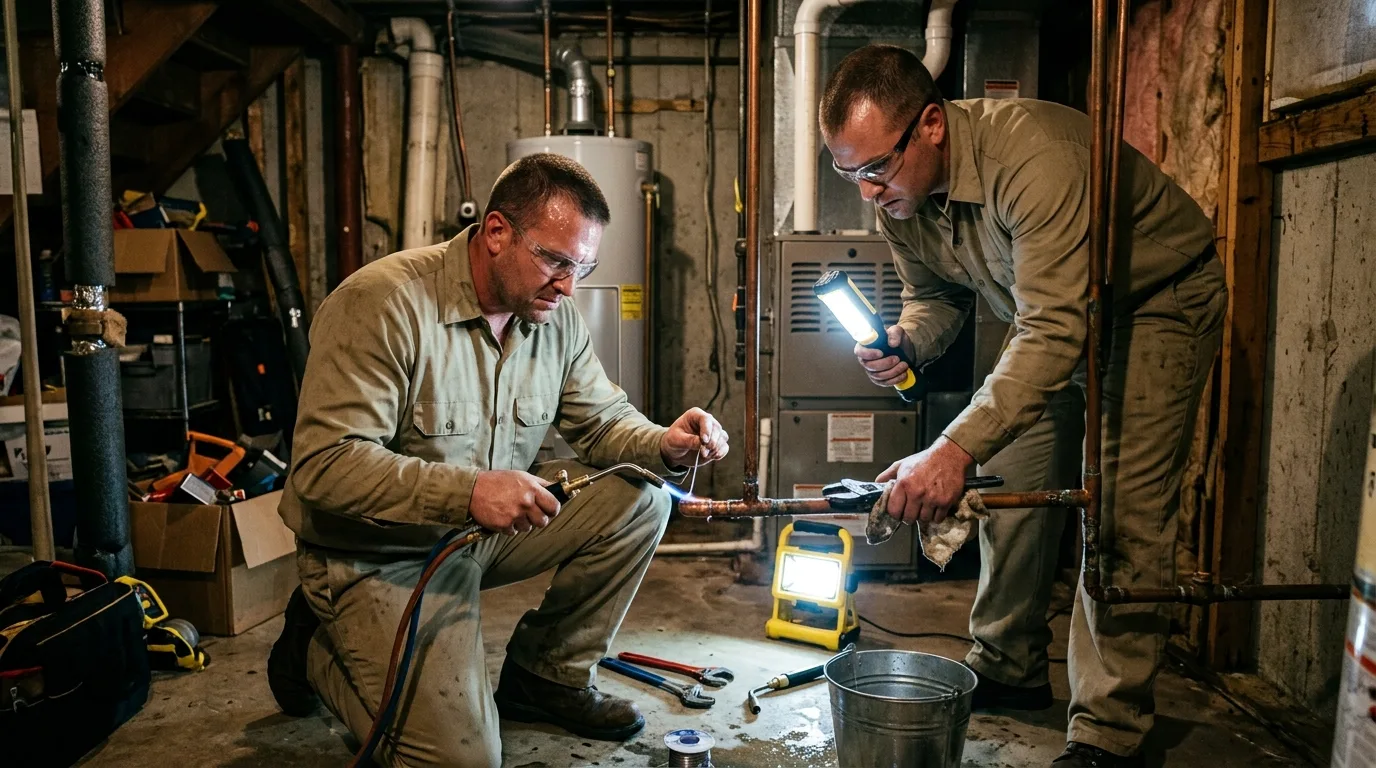
Whole-Home Repiping
When the leaks stop being events and start being a pattern.
A supply line that has opened up is a clock, not a puzzle. Get the water off, then call; we will connect you with a local pro who can cut it out and put sound pipe back in today.
If it is spraying, we will talk you to your shutoff before we talk about anything else.
Pipes almost never fail suddenly. What feels sudden is the moment a wall that has been thinning for years finally gives way at its weakest point. Understanding that changes how you should think about the repair, because the question is not only how to close the hole; it is how much of the surrounding run is in the same condition.
In this city the two common stories are corrosion and stress. Galvanized steel, standard in houses plumbed through the 1950s and 60s, rusts from the inside once its zinc coating gives out. The rust builds, the bore narrows, pressure climbs across the restriction, and eventually a thin spot or a threaded joint opens. Copper fails differently: pinhole pitting from water chemistry, erosion where a fitting turns flow too sharply, mechanical damage from a nail or an anchor, or work-hardening where a line was flexed during a remodel.
There is a third cause that catches people out, pressure. Municipal supply in parts of southeast LA County can run high, and a house with a failed pressure regulator may sit at pressures well above what flexible connectors, toilet fills and washing machine hoses are rated for. When a burst turns out to be a braided washer line or a toilet supply rather than pipe in a wall, checking static pressure is the next thing a good plumber does.
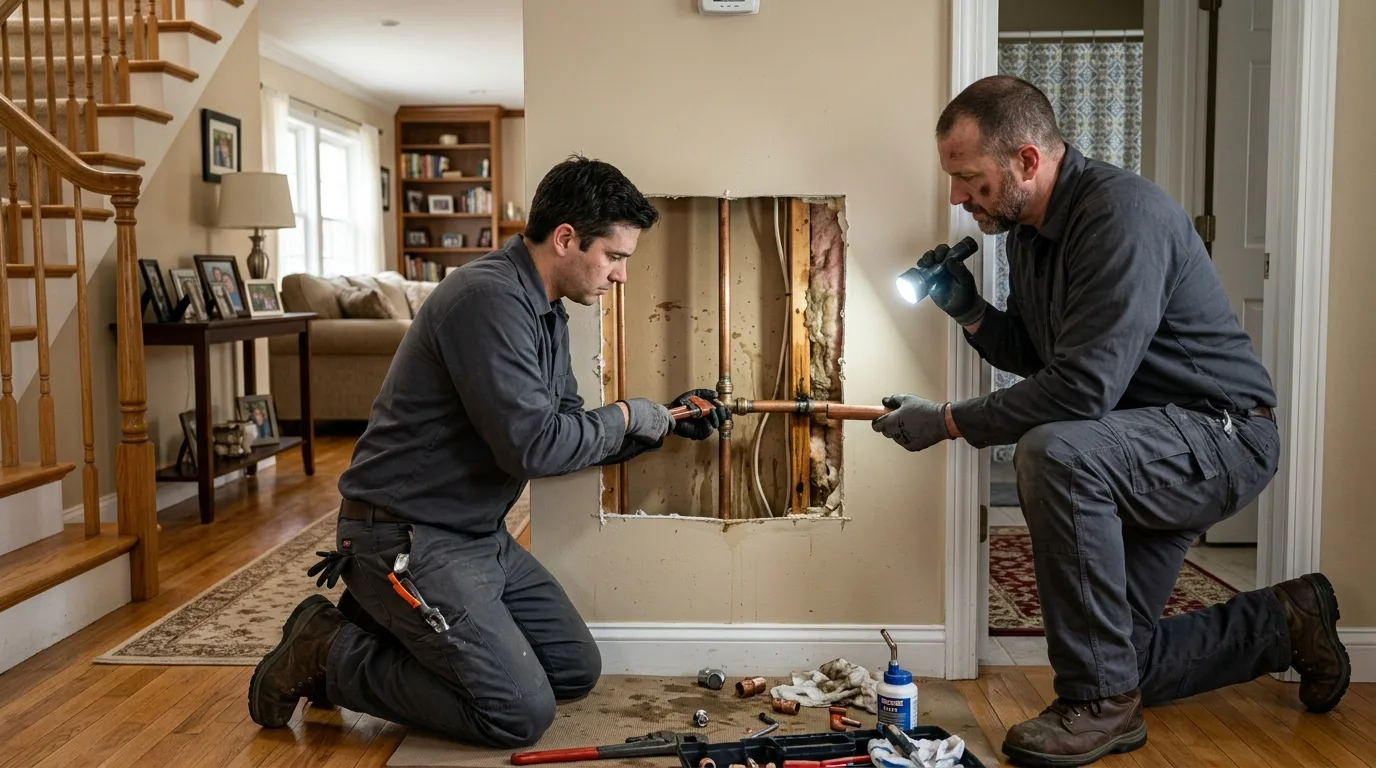 Failed galvanized
Some of these mean call tonight. Others mean call this week, before the choice is made for you.
Norwalk incorporated in 1957 and the fields became subdivisions in one compressed run. That is the single most useful fact for anyone trying to predict plumbing failures here. A block built in 1958 was plumbed with the same materials, by the same crews, to the same details, in the same year. Sixty-plus years of the same water chemistry later, those runs reach their limit together. A repipe two doors down is data about your house.
Galvanized supply lines are the main character in that story. They were entirely normal at the time and they had a good long run, but nothing about them lasts indefinitely. As the interior corrodes, you lose flow at the far end of the house first (the back bathroom, the hose bibb on the far side of the garage) and you start seeing tinting when water sits overnight. Patching one failure buys time and moves the stress downstream, which is why a second and third leak often follow within a year.
Copper in this area faces a different pressure. The water is hard, and while hardness itself is more of a heater and fixture problem, the same imported supply carries the chemistry that produces pinhole pitting in some neighbourhoods and not others. Houses that were repiped in the 70s and 80s are now old enough that their copper is not automatically the safe option people assume.
Slab-on-grade construction determines how expensive a burst becomes rather than whether it happens. With no crawlspace, some of the run is under concrete, and a failure there does not announce itself with a puddle; it warms a floor and saturates soil. Above the slab, single-story ranch layouts are actually kind to this work: attic and garage runs are reachable, and a pro can often replace a whole branch without touching a finished ceiling.
Ask any plumber who visits to put a gauge on a hose bibb and read static pressure. If it is well above the low 80s, a pressure regulator is due, and every flexible connector, fill valve and appliance hose in the building is being asked to work harder than it was designed to.
Main off, and where possible isolate just the affected branch so the rest of the house keeps water. Then the line is drained at the lowest point so the pipe can be cut without flooding the work area.
The pro opens the smallest area that gives real access, a drywall square, an attic hatch, a section of garage wall. Guessing at location is where damage gets multiplied, so if the leak is not visible, locating comes first.
This is the step that separates a repair from a callback. The cut goes back past the corroded or pitted section into material that is genuinely sound, which on failed galvanized often means further than the customer expects.
Copper for exposed runs and where the pro wants a rigid, provable joint; PEX where flexibility and fewer fittings through framing make sense. Transitions between old and new get dielectric treatment so you do not create a corrosion cell.
Water back on, pressure held and observed, every joint checked dry. Then patch. Any pro who closes the wall before testing is doing it backwards.
If the rest of the run is the same vintage and condition, you should hear that, along with what a partial or full repipe would involve. Knowing is not the same as being sold to.
Close the main, then call. The repair gets smaller every minute the water is off.
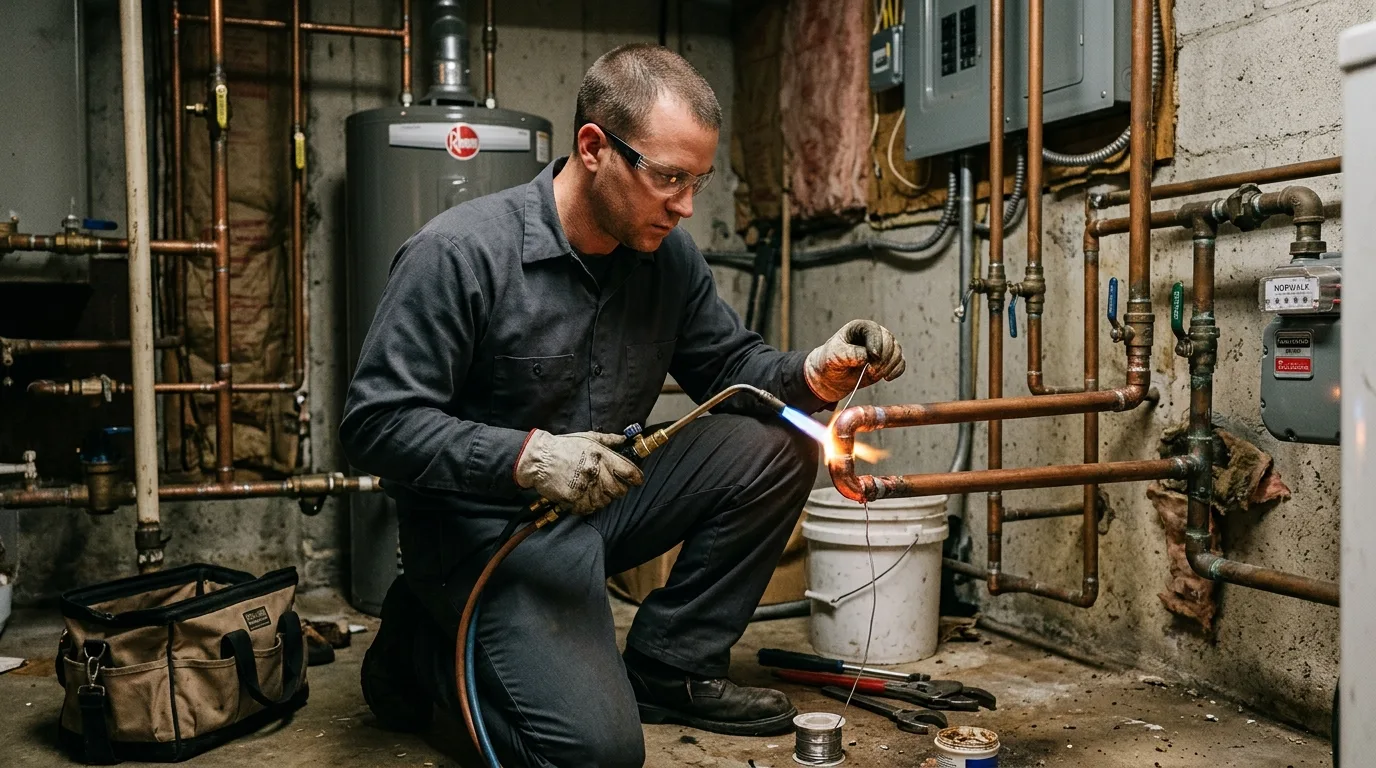 Sound pipe back in
Three honest options, and the right one depends on evidence rather than preference. A spot repair is correct when the failure is mechanical or isolated (a nail through a line, a single pitted elbow, a copper joint that eroded) and the surrounding pipe is in good shape. It is the cheapest fix and it is not a compromise when the facts support it.
A partial repipe makes sense when one branch is clearly worse than the rest: the original galvanized run to the back bathroom while the kitchen was redone in copper twenty years ago, for instance. You replace the bad branch, transition properly, and leave sound material alone. This is very common in Norwalk houses that have had a remodel or two.
A whole-home repipe is the answer when the failure is a symptom rather than an event, tinted water, falling pressure, multiple leaks in eighteen months, visible corrosion at every accessible joint. On a single-story ranch it is usually a two-to-three-day job, mostly through attic and wall cavities, with water restored each evening and drywall patching following. Copper costs more up front and is provable; PEX installs faster with fewer joints inside walls. Both are legitimate, ask the pro to explain their choice for your specific layout rather than in general.
One more consideration: if the burst is under the slab, the decision is not about pipe material at all. It is reroute versus open the concrete, and that has its own page.
Everything here is about limiting what gets wet before a pro arrives.
A minute of preparation trims real time off the visit.
A burst pipe is often the visible end of something larger. These pages cover what usually comes up in the same conversation.
When the leaks stop being events and start being a pattern.
A failure under the concrete floor is a different decision entirely.
Finding it before anyone cuts, using acoustics and pressure testing.
High static pressure quietly destroys connectors, fills and hoses.
When the failure is between the meter and the house.
Overnight and weekend dispatch when it cannot wait.
You can stop the flow, which is most of the battle. Close the main shutoff, then open the lowest tap in the house to relieve pressure and drain what is in the lines. Pipe repair clamps and tape sold at hardware stores are genuinely temporary; they can hold a small pinhole for hours, not weeks, and they will not save a split threaded joint. Use them only to buy time, and tell the pro exactly where you put them.
Look at what is wet and what is dry. Braided or plastic supply connectors at toilets, sinks and washing machines fail often, and the water is usually visible at floor level with the wall dry. Pipe failures in walls show as damp drywall, stains spreading upward or outward, and sound. If a connector failed and static pressure is high, replacing the connector without fixing the pressure just resets the clock.
Because a hole in corroded galvanized steel tells you the pipe wall is thin, not that it is thin only there. Splicing into material that is already failing produces a joint that leaks in a month and a second service call. Cutting back to genuinely sound pipe is more work on the day and much less work overall. Ask to see the cut ends; you can see the difference clearly.
Both are legitimate and both are in use across this city. Copper is rigid, provable, tolerant of heat and easy to inspect, which is why plumbers like it for exposed runs. PEX moves through framing with fewer joints, resists scale, costs less to install and handles slight movement well, which is why it dominates repipes. The real answer depends on your layout, where the runs go, and what the pro can install to a high standard.
If the wet or warm area is a floor rather than a wall, and the meter turns with all fixtures closed, that is the classic slab-leak signature. Because most houses here are slab-on-grade, it is a common finding. The fix is a different decision (reroute the line overhead or open the concrete) so it gets its own diagnosis rather than being treated as a wall-pipe repair.
Policies differ and we cannot tell you what yours does, but two things reliably help: documenting the damage before cleanup, and being able to show the failure was sudden rather than a long-ignored slow leak. Keep the plumber's invoice, which should describe what failed and what was replaced. Ask your carrier about water damage versus the cost of the pipe repair itself, because they are often treated separately.
A single accessible failure (garage wall, attic run, under-sink) is commonly an hour or two on site plus testing. A failure inside a finished wall adds access and patching. A branch replacement runs most of a day. A full repipe on a single-story house is typically two to three days with water on each night. You get a time estimate along with the price before work starts.
Very likely. That noise is water hammer, and it points at high pressure, a failed regulator, or missing arrestors. Sustained high pressure is one of the quiet reasons connectors and fill valves let go in this area. It is a small job to measure and a modest one to fix, and it protects everything downstream of it.
Yes. Say so when you call, because it changes the approach, stacked plumbing means the origin may be above you, shutoffs can serve several units, and the HOA usually needs to know before a wall is opened. Getting that established on the phone avoids an expensive standoff in a hallway while water is still moving.
Then the first failure was a symptom, and the conversation should shift from repair to replacement of that run. This is the normal pattern in houses still on original galvanized. It is worth asking, at the first failure, what the pro saw inside the cut pipe; that observation is the best early warning you will get about what the next year looks like.
One number covers all of it. If you are not sure which of these your problem is, describe it and we will tell you.
One call connects you with a local pro who does this work in Norwalk, CA houses every week, and prices it before starting.