Slab leak repair
What the job involves, what it costs to put right, and how quickly it needs doing.
Most of Norwalk went up between 1948 and 1962, thousands of near-identical slab-on-grade houses built quickly for aerospace families. Seventy years later they are all failing in the same place, at roughly the same time.
· 6 min read · Reviewed by Derek Lawson, Senior Plumbing Specialist
A slab-on-grade house has no crawlspace. The water supply lines run through or under the concrete pad the house sits on. In the post-war building boom that was the cheap, fast way to do it, and soft copper tubing was the material of the moment.
Soft copper is fine in open air. Buried in concrete, in contact with alkaline soil, carrying hard mineral-heavy water at Southern California pressures, it does two things over decades: it abrades where the concrete moves against it, and it corrodes from the outside in. Both produce the same eventual result, a pinhole.
The reason Norwalk sees so many of these is simply arithmetic. Same era, same builders, same copper, same water. When one house on a street develops a slab leak, its neighbours are usually a few years behind it.
Slab leaks rarely announce themselves. Water goes down and sideways before it comes up, so the symptoms are indirect for weeks or months:
Turn off every fixture and appliance in the house, then look at the water meter. If the low-flow indicator is still creeping, water is escaping somewhere between the meter and your fixtures. That does not prove a slab leak, but it proves a leak.
Nobody opens a slab to go looking. Location comes first, and it is done non-destructively: the line is isolated and pressurised, then acoustic listening equipment and thermal imaging narrow the escape point to within a foot or so. On a hot-water line an infrared camera often finds it in minutes because the escaping water heats the concrete above it.
That precision matters enormously to the cost of the repair. A leak located to a square foot is a small, targeted job. A leak located to “somewhere in the kitchen” is a demolition project.
Spot repair. Cut the floor at the located point, expose the pipe, replace the failed section, patch. Cheapest and least invasive, and the right answer for a young house with one failure.
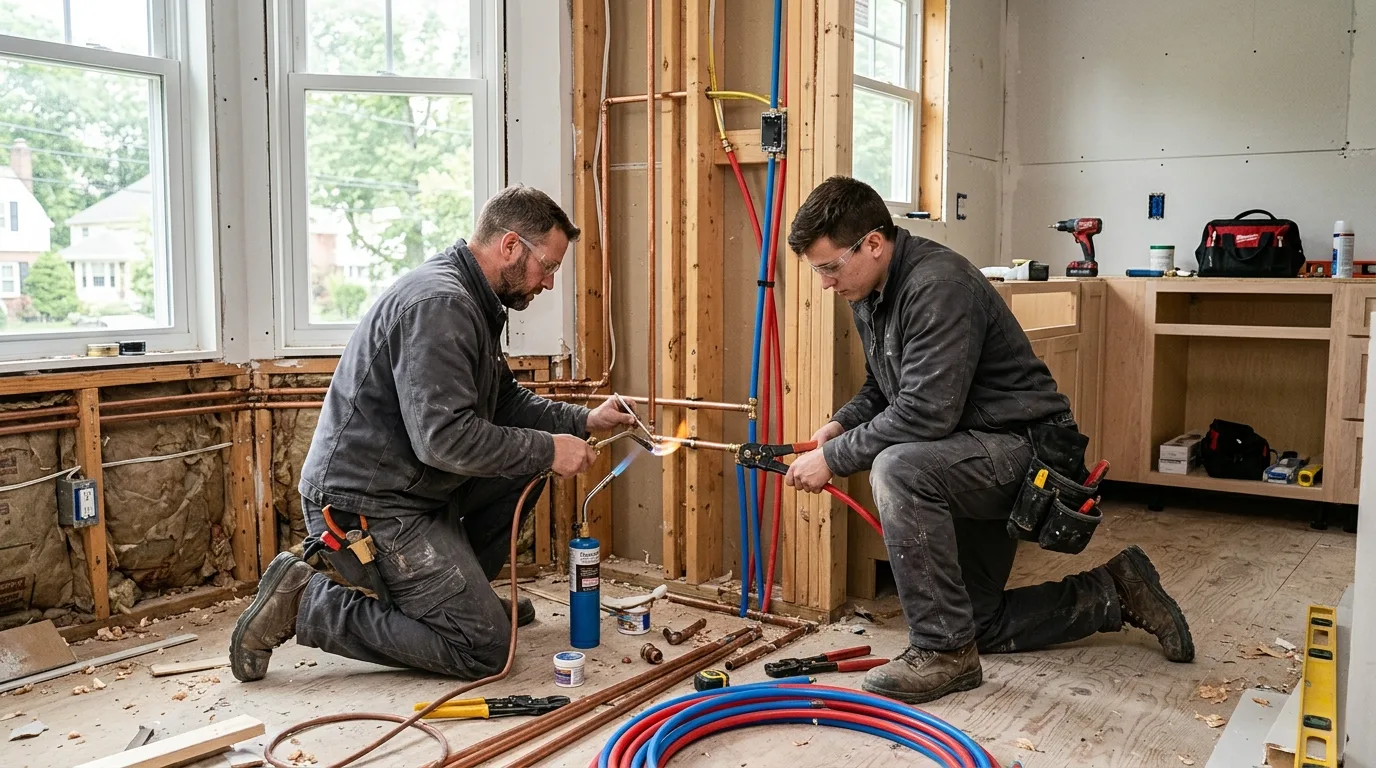
Reroute. Abandon the buried run entirely and pull a new line overhead through the attic and down the walls. No concrete work at all beyond the tie-in points. Usually the sensible choice for one bad run in an otherwise sound system.
Repipe. Replace the whole supply system. This becomes the honest recommendation once you have had two or three leaks, because at that point you are not fixing failures; you are queuing for them.
First slab leak in a house: repair or reroute it and move on. Second leak within two years: seriously price a repipe. Third: the copper has told you what it intends to do.
A slab leak is a plumbing failure, not a foundation failure. Homeowners hear “water under the slab” and picture structural collapse. Left running for a very long time it can undermine soil, but a leak found in its first months and repaired properly leaves the foundation exactly as it was.
The thing that does get expensive is delay. Water running under concrete for a year ruins flooring, wicks into drywall, and turns a targeted repair into a remediation job.
What the job involves, what it costs to put right, and how quickly it needs doing.
Diagnosis, options and honest trade-offs before anyone starts cutting.
Practical writing about the plumbing problems this corner of Los Angeles County actually has.
A step-by-step for the first five minutes of a burst pipe: shutting off water, killing power safely, and what to photograph before you start cleaning up.
Norwalk tap water runs hard. Here is what the mineral load does to water heaters, fixtures and copper over time, and when softening is worth the money.
A cable clears a blockage. A jetter cleans the pipe. Knowing which your drain needs saves money on the wrong job and repeat visits on the right one.
One call, a plain description of the problem, and an honest answer on how urgent it is.